Why Small-Town Bands Stay Stuck at 20 fans (And How to Break the Cycle)
If you’re playing original music in a small town, you’ve probably seen it happen: You play a show. Twenty people show up. Next month? Twenty again. Six months later? Still twenty. It feels stable. It feels supportive. It even feels loyal. But it isn’t growth.
For many small-town bands, that “consistent 20” becomes a ceiling instead of a foundation. The good news? It’s not a talent issue. It’s a strategy issue.
Let’s break down why attendance plateaus — and how to build real momentum in a small local music scene.
The 20-Person Trap: Why Stable Attendance Isn’t Growth
In smaller markets, your first 15–25 fans are usually friends, coworkers, partners, and people already in your circle. That base is important. But if you keep playing to the same group without expanding beyond it, your band becomes predictable. And predictable kills urgency.
When people think: “They play all the time. I’ll catch the next one.” They often don’t.
Growth requires expanding beyond your existing circle. That doesn’t happen automatically — it requires intentional strategy.
Overplaying Reduces Urgency
One of the biggest mistakes small-town original bands make is overplaying. It feels productive to book every available date. But frequency without demand reduces perceived value.
If you play:
- The same venue every 3 weeks
- The same lineup repeatedly
- The same time slot
You train your audience not to prioritize your shows. Strategic scarcity creates anticipation. Instead of playing monthly at the same bar, try:
- One strong headlining show every 8–10 weeks
- A themed “Originals Night”
- A curated bill with complementary bands
When shows feel intentional, they feel important.
Curated Three-Band Bills Stack Audiences
Fragmented lineups divide audiences. Strategic bills stack them. If you’re trying to grow show attendance in a small town, stop thinking like a solo act and start thinking like a scene builder.
A curated three-band lineup works because:
- Each band brings their core supporters
- Audiences cross-pollinate
- The night feels like an event
Instead of 20 people for each band separately, you can create a 50–70 person room by stacking audiences strategically. The key is alignment.
Choose bands that:
- Play original music
- Complement your style
- Actively promote
This builds momentum for everyone involved.
Email Lists Beat Social Algorithms (Every Time)
Relying only on Instagram or Facebook to promote shows is risky. Algorithms change. Reach drops. Posts get buried. An email list gives you direct access to the people who already care. When someone joins your list, they’ve raised their hand. That’s a warmer connection than a follower.
If you want to grow a local music scene:
- Collect emails at every show
- Offer a free download or demo
- Send simple show announcements
- Share behind-the-scenes updates
You control the communication channel.
In small towns, relationships drive attendance. Email strengthens those relationships consistently.
Track Attendance and Merch to Find What Actually Works
Most small-town bands guess what works. Very few track it.
After every show, record:
- Estimated attendance
- Merch sold
- Email signups
- Which bands were on the bill
- Promotion methods used
Patterns emerge quickly.
You may discover:
- Shows with three bands outperform solo nights
- Saturday shows double Friday attendance
- Certain venues convert better for merch
- Themed nights outperform casual gigs
Data removes emotion from decision-making.
If your goal is to grow beyond 20 people, tracking becomes your unfair advantage.
Build Demand, Don’t Just Book Shows
The shift small-town bands need to make is simple:
Stop thinking “Where can we play next?” Start thinking “How do we make the next show feel unmissable?”
Demand is built through:
- Strategic scarcity
- Intentional lineups
- Consistent email communication
- Tracking and improving each event
You don’t need a bigger city.
You need a system.
The Real Goal: Build a Sustainable Local Originals Scene
Small towns don’t lack audiences. They lack organization. When bands coordinate instead of compete, when shows feel curated instead of random, and when communication is consistent, scenes grow. Twenty people isn’t failure. It’s the foundation. The question is whether you’ll keep circling that number — or build on top of it.
If you’re serious about organizing your venues, tracking outreach, and building a repeatable system for booking original shows in your town, start with structure. Growth follows consistency.

Get The FREE venue tracker spreadsheet.
A FREE starter spreadsheet for original bands outside major music cities
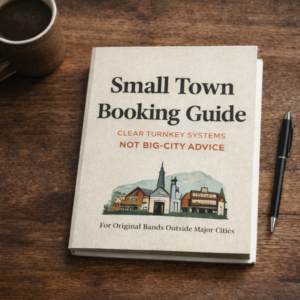
A practical booking guide for original bands in small markets.
Includes strategy, checklists, and editable venue tracking spreadsheets.